About Matt Grau
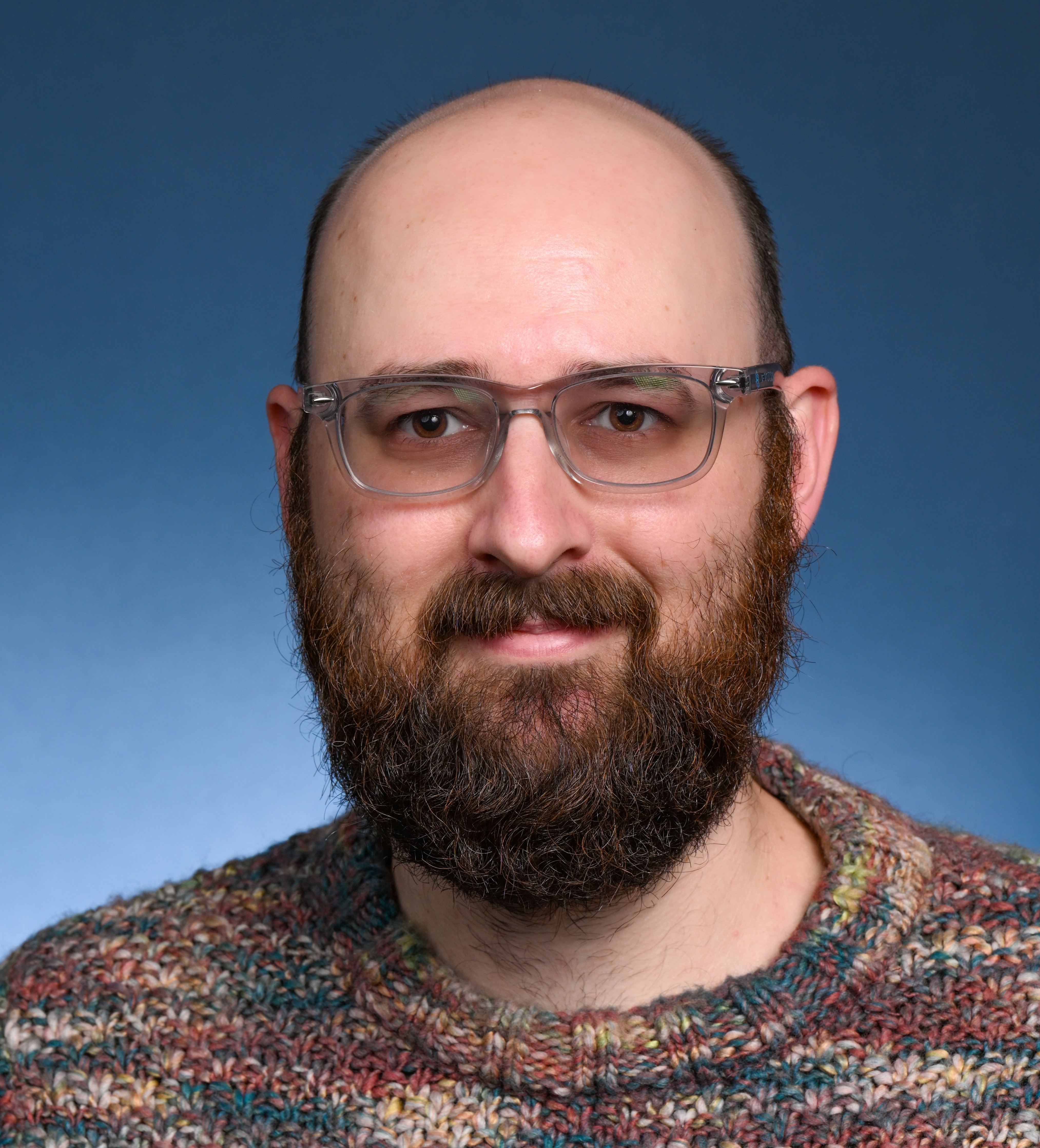
Matt Grau
Assistant Professor
Department of Physics
Old Dominion University
Room 2100K, Oceanography & Physical Sciences
Norfolk, VA 23529
(757) 683-5827
[email protected]
Research Interests
My group works in experimental atomic physics, using trapped ions as a precision tool for quantum information and fundamental physics. I have several research interests:
- Ba⁺ quantum information — using trapped barium ions for quantum computation and simulation
- Hybrid qubit-qumode computing — theoretical and experimental exploration of trapped-ion platforms combining discrete (qubit) and continuous-variable (qumode) degrees of freedom for simulating quantum field theories
- Nuclear CP violation — precision spectroscopy of heavy molecular ions to search for CP-violating nuclear magnetic quadrupole moments and the electron electric dipole moment
- Spin-polarized photocathodes — developing high-performance semiconductor electron sources for particle accelerators, in collaboration with ODU ECE and Jefferson Lab
See the Research page for more detail.
Education
| Year | Degree | Institution |
|---|---|---|
| 2016 | Ph.D., Physics | University of Colorado Boulder |
| 2012 | M.S., Physics | University of Colorado Boulder |
| 2009 | B.S., Physics | California Institute of Technology |
Ph.D. Thesis: “Measuring the electron electric dipole moment with trapped molecular ions”
Academic Appointments
| Years | Position | Institution |
|---|---|---|
| 2021 – present | Assistant Professor | Old Dominion University, Norfolk, VA |
| 2020 – 2021 | Senior Scientist (Oberassistent) | ETH Zürich, Switzerland |
| 2016 – 2019 | Postdoctoral Research Associate | ETH Zürich, Switzerland |
| 2009 – 2016 | Graduate Research Assistant | JILA, University of Colorado Boulder |
Awards and Honors
- 2025 — ODU SCHEV Outstanding Faculty Award “Rising Star” Nominee
- 2024 — Tenure Track Faculty Distinguished Teaching Award, ODU College of Sciences
Calendar
Bio
I was born in Fairfax and grew up in Chantilly, Virginia, where I attended Thomas Jefferson High School. There I was a member of the Policy Debate team and a volunteer sysadmin for the computer lab. I went to college at Caltech, where I was a member of Lloyd House, served as Chair of the Board of Control, and majored in Physics. I did some research with Michael Cross and Mason Porter on the theory of synchronization of nonlinear oscillators. I was drawn to condensed matter theory and tried to attend the weekly condensed matter theory seminar series. It was at one of these seminars that I saw an amazing talk by Brian DeMarco at UIUC on quantum simulation in optical lattices. I reached out to Brian to see if I could work in his lab for the summer, and he graciously agreed to host me. As soon as I aligned my first tapered amplifier, I was absolutely hooked on AMO physics. I went to graduate school at the University of Colorado Boulder, where I worked with Eric Cornell and Jun Ye at JILA on a precision measurement to search for the electron electric dipole moment with trapped molecular ions. Finding that I really enjoyed building and working on the most challenging and technical aspects of experiment electronics and computer control, I joined Jonathan Home’s trapped-ion quantum information group at ETH Zürich for my postdoc. In Zürich, I worked on an experiment to trap ions in an optical lattice in a power-enhancement cavity, a scalable Penning trap experiment, and a demonstration barium ion trap for science communication. Eventually I moved back to Virginia to start an AMO group at Old Dominion University in Norfolk.