Using trapped Ba⁺ ions as a platform for quantum information processing.
Trapping a Single Ion
An ion trap confines charged atoms using electric fields, suspending them in space. Our trap is a linear Paul trap, which comprises four metal electrodes arranged in a square, driven with a radio-frequency voltage. The resulting oscillating electric field creates an effective potential well that pushes ions toward the central axis. Static voltages applied to end-cap electrodes confine the ion axially. The result is a single, isolated ion levitating in vacuum, confined by electric fields.
Our linear Paul trap for Ba⁺ ions at Old Dominion University.
Laser Cooling and Fluorescence
At room temperature, atoms move at hundreds of meters per second. To trap and control a single ion, we first need to slow it down. We do this with laser cooling. By tuning a laser to just below the energy of ann atomic transition, the ion preferentially absorbs photons from whichever direction it is moving toward, receiving a small momentum kick opposing its motion with each absorption. After millions of such kicks, the ion’s average speed drops to less than 1 meter per second, which corresponds to a temperature of less than a thousandth of a degree above absolute zero. This localizes the atom to a volume less than 100 nm on a side.
Once laser-cooled, the ion fluoresces. When illuminated by a resonant laser, a single Ba$^+$ ion scatters tens of millions of photons per second. We image this light with a camera and a microscope lens. Each trapped ion appears as a bright spot in the image.
Single Ba⁺ ions fluorescing under 493 nm laser illumination. Each bright spot is one atom.
The Qubit
A quantum bit, known as a “qubit”, is any two-level quantum system. In Ba$^+$, we use two hyperfine levels of the $S_{1/2}$ ground state as our qubit. These states are separated by a microwave frequency and are insensitive to magnetic field fluctuations at a clock transition, giving long coherence times. We prepare and manipulate the qubit using stimulated Raman transitions driven by 515 nm laser pulses, and read it out by state-selective fluorescence. One qubit state will appear “bright”, and the other appears “dark”, rendering the qubit into a classical bit.
Two-qubit gates between neighboring ions are mediated by their shared motional modes, the collective oscillations of the ion chain in the trap. By coupling internal qubit states to these shared motions, we can perform entangling gates.
Integration of a high finesse cryogenic build-up cavity with an ion trap
Oliver Wipfli, Henry Fernandes Passagem, Christoph Fischer, Matt Grau, and Jonathan P. Home
Rev. Sci. Instrum.94, 8 (Aug 2023)
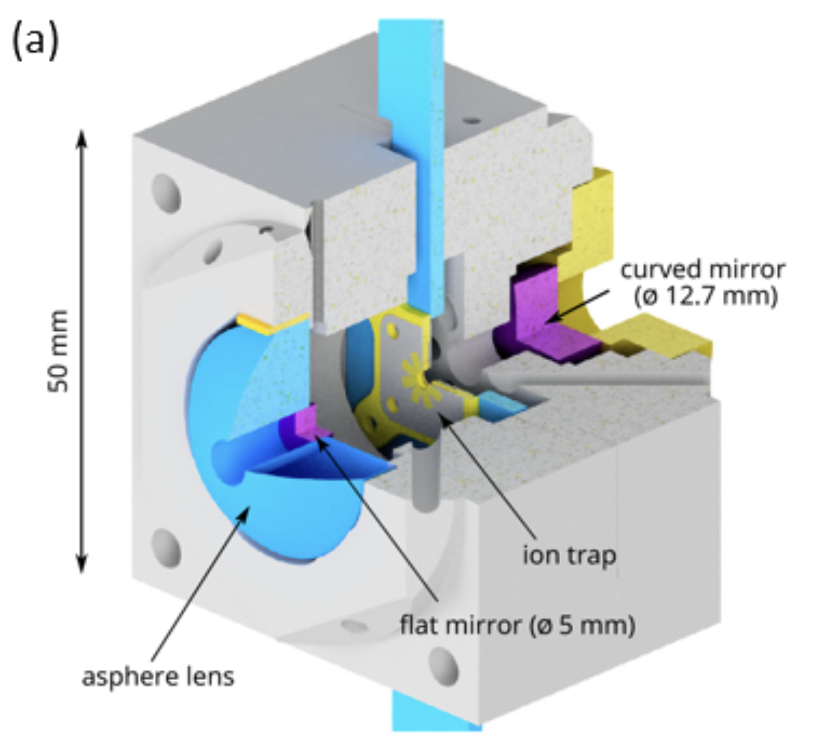
We report on the realization of a hemispherical optical cavity with a finesse of $\mathcal{F} = 13000$ sustaining inter-cavity powers of 10 kW, which we operate in a closed-cycle cryostat vacuum system close to 4 Kelvin. This was designed and built with an integrated radio-frequency Paul trap, in order to combine optical and radio-frequency trapping. The cavity provides a power build-up factor of 2250. We describe a number of aspects of the system design and operation, including low-vibration mounting and locking including thermal effects at high powers. Thermal self-locking in the high intracavity power regime was observed to enhance the passive stability below 1 kHz. Observations made over repeated cool-downs over a course of a year show a repeatable shift between the ion trap center and the cavity mode.
Engineering generalized Gibbs ensembles with trapped ions
Florentin Reiter, Florian Lange, Shreyans Jain, Matt Grau, Jonathan P Home, and Zala Lenarcic
Phys. Rev. Res.3, 3 (Aug 2021)
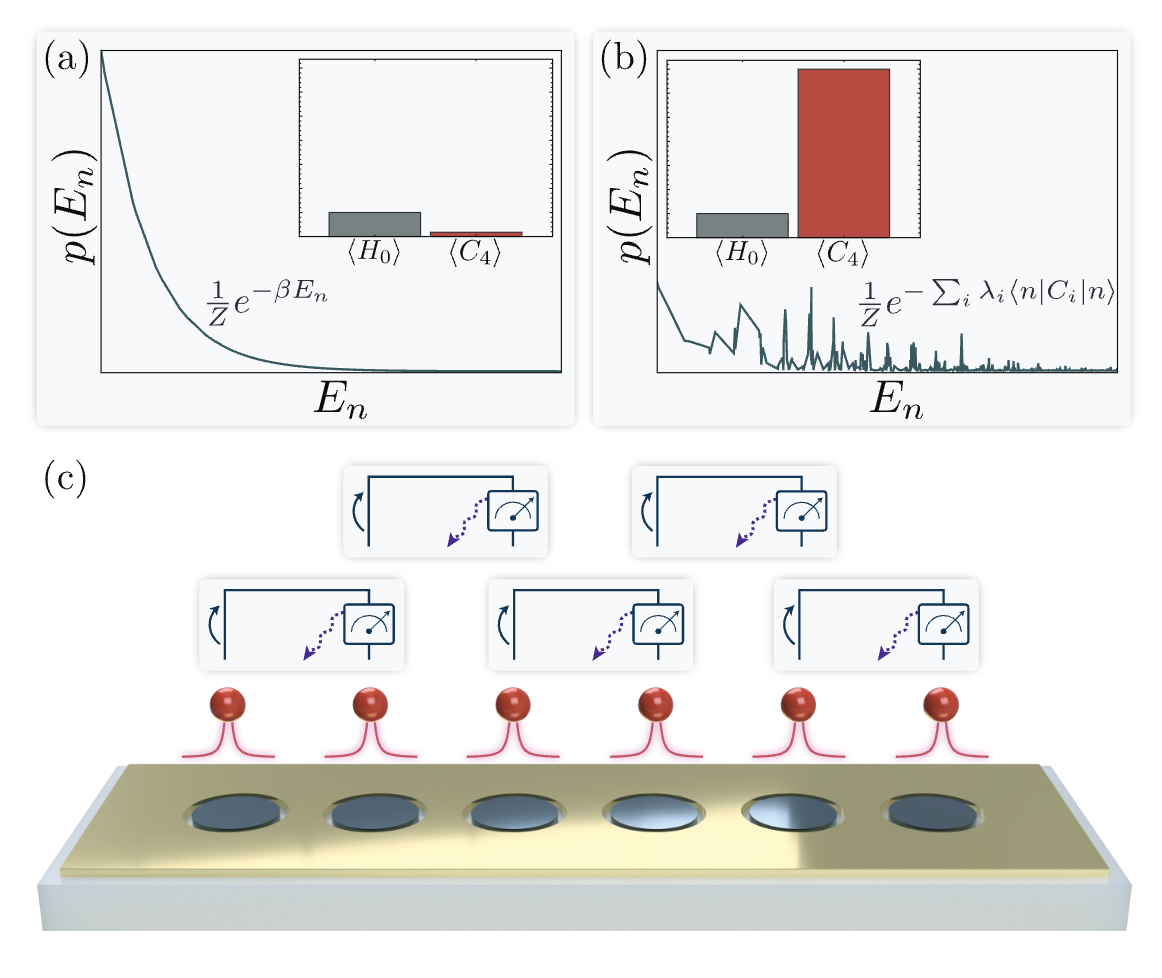
The concept of generalized Gibbs ensembles (GGEs) has been introduced to describe steady states of integrable models. Recent advances show that GGEs can also be stabilized in nearly integrable quantum systems when driven by external fields and open. Here, we present a weakly dissipative dynamics that drives towards a steady-state GGE and is realistic to implement in systems of trapped ions. We outline the engineering of the desired dissipation by a combination of couplings which can be realized with ion-trap setups and discuss the experimental observables needed to detect a deviation from a thermal state. We present a novel mixed-species motional mode engineering technique in an array of micro-traps and demonstrate the possibility to use sympathetic cooling to construct many-body dissipators. Our work provides a blueprint for experimental observation of GGEs in open systems and opens a new avenue for quantum simulation of driven-dissipative quantum many-body problems.
Scalable Arrays of Micro-Penning Traps for Quantum Computing and Simulation
S. Jain, J. Alonso, M. Grau, and J. P. Home
Phys. Rev. X10, 3 (Aug 2020)
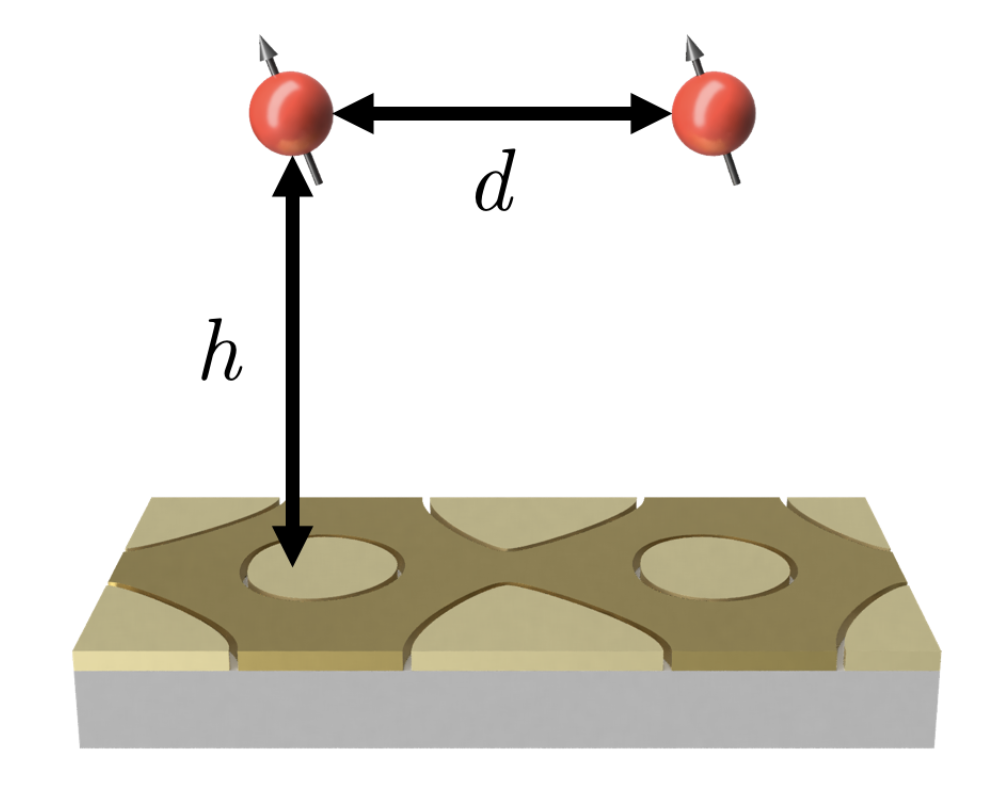
We propose the use of 2-dimensional Penning trap arrays as a scalable platform for quantum simulation and quantum computing with trapped atomic ions. This approach involves placing arrays of micro-structured electrodes defining static electric quadrupole sites in a magnetic field, with single ions trapped at each site and coupled to neighbors via the Coulomb interaction. We solve for the normal modes of ion motion in such arrays, and derive a generalized multi-ion invariance theorem for stable motion even in the presence of trap imperfections. We use these techniques to investigate the feasibility of quantum simulation and quantum computation in fixed ion lattices. In homogeneous arrays, we show that sufficiently dense arrays are achievable, with axial, magnetron and cyclotron motions exhibiting inter-ion dipolar coupling with rates significantly higher than expected decoherence. With the addition of laser fields these can realize tunable-range interacting spin Hamiltonians. We also show how local control of potentials allows isolation of small numbers of ions in a fixed array and can be used to implement high fidelity gates. The use of static trapping fields means that our approach is not limited by power requirements as system size increases, removing a major challenge for scaling which is present in standard radio-frequency traps. Thus the architecture and methods provided here appear to open a path for trapped-ion quantum computing to reach fault-tolerant scale devices.