Searching for CP-violating nuclear interactions using molecular ions as ultra-sensitive probes of physics beyond the Standard Model.
The Matter-Antimatter Puzzle
The apparent lack of antimatter in the universe is one of the great mysteries in physics. At the origins of the universe, equal amounts of matter and antimatter should have been produced and soon after annihilated, leaving only photons. However, we live in a universe that is predominantly composed of matter, with essentially no antimatter observed. This asymmetry cannot be explained by the Standard Model of particle physics, which predicts CP violation far too weakly to account for the imbalance. The asymmetry could be explained by hypothetical new particles or forces that violate CP symmetry at high energy. Our research program searches for the small residual effects of such new-physics particles on low-energy precision measurements of atoms and molecules, rather than attempting to produce them directly at particle colliders.
One of the best places to look for new sources of CP violation is in the structure of atomic nuclei. CP-violating interactions can induce tiny, otherwise forbidden distortions of the nucleus. A particularly sensitive probe is the nuclear magnetic quadrupole moment (MQM), which can only be nonzero if CP symmetry is broken and is often enhanced in deformed nuclei with unpaired nucleons.
Molecular Enhancement and the LuOH⁺ System
We have identified the molecular ion LuOH$^+$ as a particularly favorable system for this measurement. The $^{176}$Lu nucleus has a large quadrupole deformation and a high-spin ground state ($I=7$), giving rise to enhanced sensitivity to a nuclear MQM. Calculations indicate that LuOH$^+$ is among the most sensitive molecules proposed for MQM searches. A nonzero measurement of the MQM in LuOH$^+$ can be translated into constraints on the QCD vacuum angle $\bar\theta$, quark electric dipole moments, and quark chromo-EDMs—parameters that quantify CP violation in the strong sector.
Quantum Logic Spectroscopy
The central challenge of precision spectroscopy with molecular ions is state preparation and detection. Unlike atoms, molecules have a rich internal structure with thousands of rotational, vibrational, and electronic states, making it impossible to read out the quantum state directly by fluorescence. We address this using quantum logic spectroscopy (QLS), a technique borrowed from atomic clock research in which a co-trapped atomic ion (the “logic ion”) shares a trap with the molecule of interest (the “spectroscopy ion”). Quantum gates transfer information about the molecular quantum state onto the logic ion, which is then read out by fluorescence. Working with a single molecule rather than an ensemble of thousands also provides better protection from systematic errors arising from sample and field inhomogeneity over the experimental volume.
Schematic of quantum logic spectroscopy. A co-trapped atomic ion (left) acts as the readout ancilla for the molecular ion (right), connected via shared motional modes.
Quantum logic control and precision measurements of molecular ions in a ring trap: An approach for testing fundamental symmetries
Yan Zhou, Joshua O. Island, and Matt Grau
Phys. Rev. A109, 3 (Mar 2024)
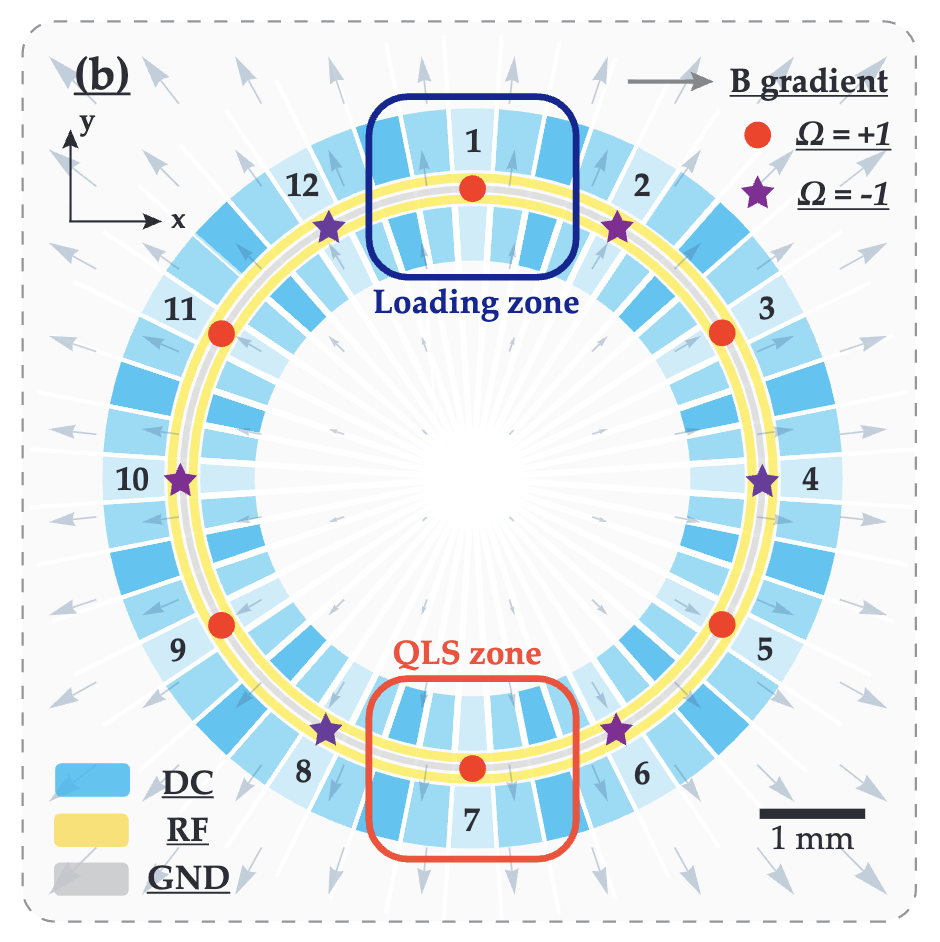
We present a new platform facilitating quantum logic control of polar molecular ions in a segmented ring ion trap, paving the way for precision measurements. This approach focuses on achieving near-unity state preparation and detection, as well as long spin coherence. A distinctive aspect lies in separating state preparation and detection conducted in a static frame, from parity-selective spin-precession in a rotating frame. This method can be applied to a wide range of ion species and will be used to search for the electron's electric dipole moment and the nuclear magnetic quadrupole moment.
Nuclear magnetic quadrupole moment of $^{175}$Lu and parity-violating polarization degree of levels in $^{175}$LuOH$^{+}$
Igor Kurchavov, Daniel Maison, Leonid Skripnikov, Matt Grau, and Alexander Petrov
Phys. Rev. A108, 5 (Nov 2023)
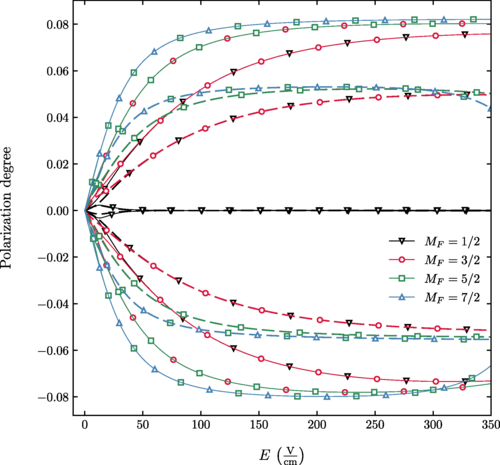
The calculation of the parity-violating polarizations in the external electric field, which are associated with the electron electric dipole moment (eEDM) and magnetic quadrupole moment (MQM) of the $^{175}$Lu nucleus, as well as the determination of the rovibrational structure for the $^{175}$LuOH$^+$ cation, is performed. Beyond the bending of the molecule, the slight effect of the stretching of the distance between Lu and OH is taken into account. This study is required for the preparation of the experiment and for the extraction of the eEDM and MQM values of $^{175}$Lu from future measurements.
$\mathcal{T},\mathcal{P}$-odd effects in the LuOH$^{+}$ cation
Daniel E. Maison, Leonid V. Skripnikov, Gleb Penyazkov, Matt Grau, and Alexander N. Petrov
Phys. Rev. A106, 6 (Dec 2022)
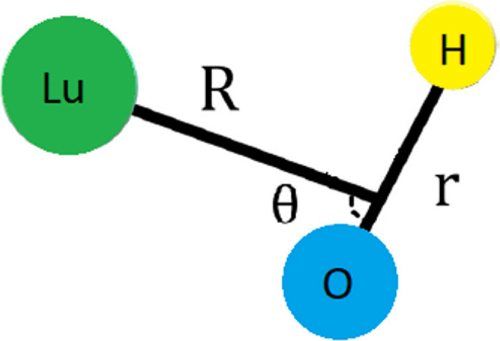
The LuOH$^+$ cation is a promising system to search for manifestations of time reversal and spatial parity violation effects. Such effects in LuOH$^+$ induced by the electron electric dipole moment (eEDM) and the scalar-pseudoscalar interaction of the nucleus with electrons, characterized by $k_s$ constant, are studied. The enhancement factors, polarization in the external electric field, hyperfine interaction, and rovibrational structure are calculated. The study is required for the experiment preparation and extraction of the eEDM and $k_s$ values from experimental data.
Experimental Constraint on Axionlike Particles over Seven Orders of Magnitude in Mass
Tanya S. Roussy, Daniel A. Palken, William B. Cairncross, Benjamin M. Brubaker, Daniel N. Gresh, Matt Grau, Kevin C. Cossel, Kia Boon Ng, Yuval Shagam, Yan Zhou, Victor V. Flambaum, Konrad W. Lehnert, Jun Ye, and Eric A. Cornell
Phys. Rev. Lett.126, 17 (2021)
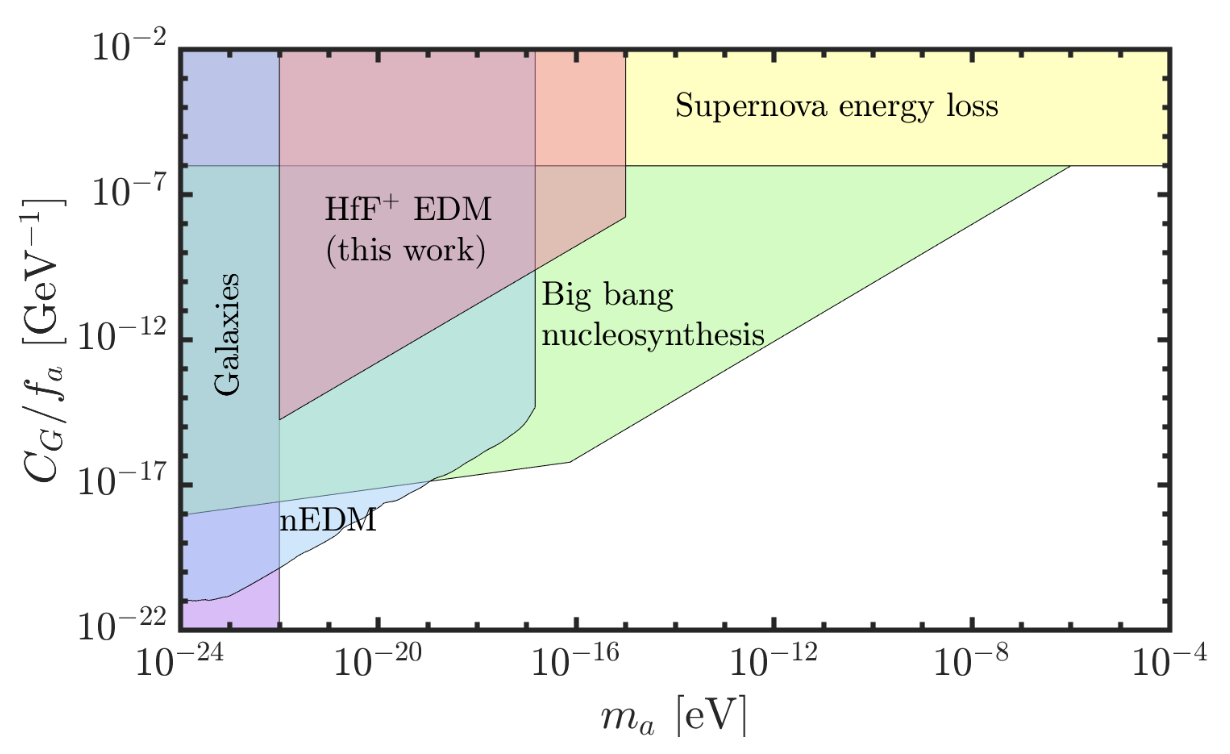
We use our recent electric dipole moment (EDM) measurement data to constrain the possibility that the HfF$^+$ EDM oscillates in time due to interactions with candidate dark matter axion-like particles (ALPs). We employ a Bayesian analysis method which accounts for both the look-elsewhere effect and the uncertainties associated with stochastic density fluctuations in the ALP field. We find no evidence of an oscillating EDM over a range spanning from 27 nHz to 400 mHz, and we use this result to constrain the ALP-gluon coupling over the mass range $10^{-22}$--$10^{-15}$ eV. This is the first laboratory constraint on the ALP-gluon coupling in the $10^{-17}$--$10^{-15}$ eV range, and the first laboratory constraint to properly account for the stochastic nature of the ALP field.
Search for CP-violating nuclear magnetic quadrupole moment using the LuOH$^+$ cation
D. E. Maison, L. V. Skripnikov, V. V. Flambaum, and M. Grau
J. Chem. Phys.153, 22 (2020)
The CP-violating interaction of the nuclear magnetic quadrupole moment (MQM) of the $^{175}$Lu nucleus with electrons in the molecular cation LuOH$^+$ is studied. The resulting effect is expressed in terms of CP-odd parameters, such as quantum chromodynamics angle $\bar{\theta}$, quark electric dipole moment (EDM) and chromo-EDM. For this we have performed a calculation of the nuclear MQM as well as the molecular constant that characterises the interaction of this MQM of $^{175}$Lu with electrons. Additionally, we predict the hyperfine structure constants for the ground electronic state of LuOH$^+$. We conclude that LuOH$^+$ is a promising system to measure the nuclear MQM.