Developing next-generation spin-polarized electron sources for particle accelerators, in collaboration with ODU ECE and Jefferson Lab.
This work is done in collaboration with the Sylvain Marsillac’s group in Electrical & Computer Engineering, and the Electron Gun Group at Jefferson Lab
Why Spin-Polarized Electrons?
Many important experiments in nuclear and particle physics require electron beams where the electrons all spin in the same direction. At CEBAF at Jefferson Lab in Newport News, Virginia, spin-polarized electrons are used to probe the internal structure of protons and neutrons, map the distribution of quarks and gluons inside the nucleus, and search for signatures of physics beyond the Standard Model. The degree of beam polarization directly determines the sensitivity of these experiments. A more highly polarized beam means cleaner results with less beam time.
Spin-polarized electron beams are produced by shining a laser on a specially engineered semiconductor called a photocathode, which then emits electrons. The challenge is to make both the spin polarization and the photoemission efficiency (quantum efficiency, or QE) as high as possible simultaneously.
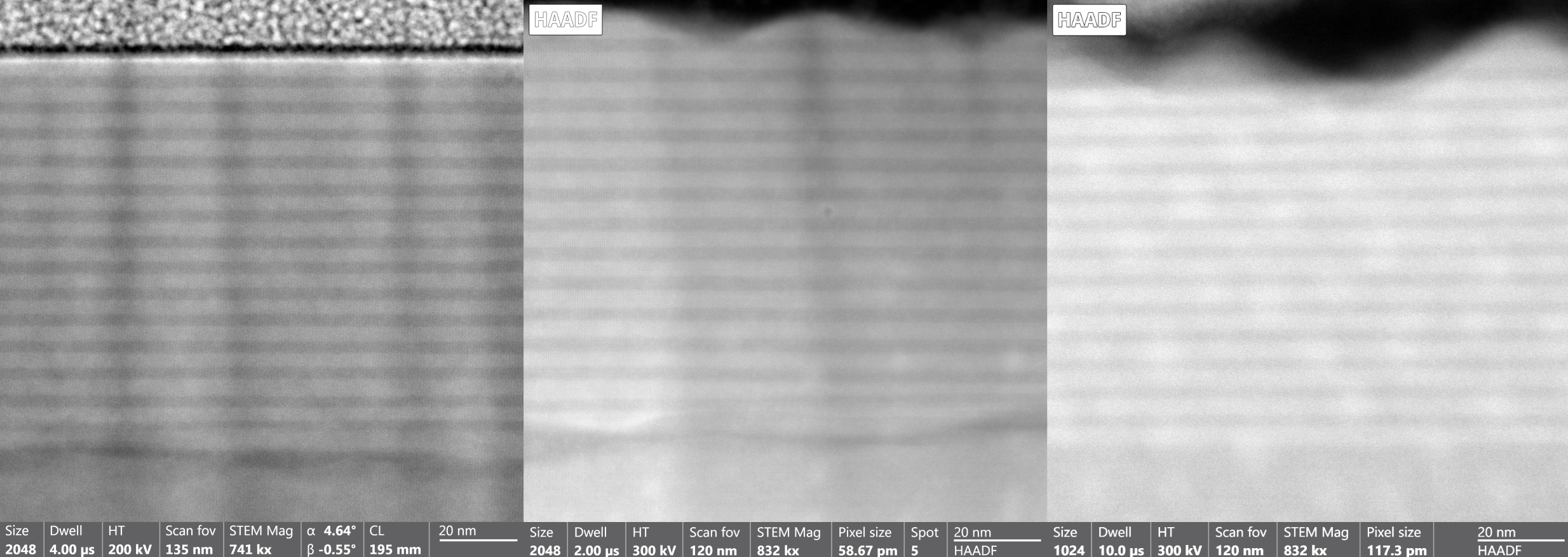
A GaAs-based strained superlattice photocathode mounted on its stalk for installation in the polarized source.
How Strained Semiconductors Produce Spin-Polarized Electrons
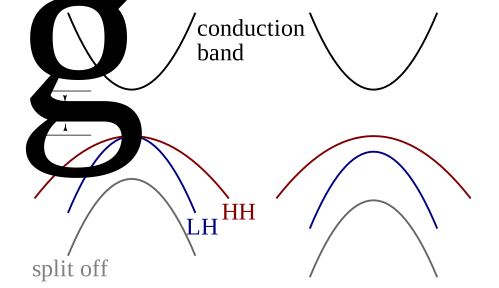
In bulk GaAs, the valence band contains two types of states with different total angular momentum: heavy holes ($m_j = \pm 3/2$) and light holes ($m_j = \pm 1/2$). When a circularly polarized laser excites electrons from the valence band to the conduction band, the heavy-hole and light-hole transitions contribute electrons with opposite spin polarization, partially canceling each other out. In a typical crystal, the theoretical maximum polarization is 50%.
If we apply mechanical strain to the crystal this splits the heavy-hole and light-hole energy bands. If the splitting is large enough, only heavy-hole electrons are excited by the laser, and the photoemitted electrons can reach polarizations approaching 100%. We introduce strain to the photocathode by growing thin layers of GaAs sandwiched between layers of a different semiconductor in a superlattice structure. Mismatched lattice constants between the layers create a built-in compressive or tensile stress that splits the bands.
Schematic band structure of GaAs without strain (left) and with compressive strain (right). Strain splits the heavy-hole (HH) and light-hole (LH) valence bands, enabling selective excitation and spin polarization approaching 100%.
In addition to strain, quantum confinement in the thin GaAs quantum wells further enhances the band splitting. When electrons are confined to a layer only a few nanometers thick, their energies are quantized (like a particle in a box), and the confinement energy shifts the heavy-hole and light-hole levels by different amounts, adding to the strain-induced splitting. By carefully engineering both the composition and thickness of each layer, we can maximize the splitting while maintaining good electron transport to the surface.
Fabry-Perot resonance shifts as a novel nondestructive in situ surface damage diagnostic
Gregory Blume, Colin Kirk, Sushil Poudel, John Hill, Alimohammed Kachwala, Joseph Grames, Marcy L. Stutzman, Matt Grau, and Sylvain Marsillac
(Sep 2026)
Current surface damage evaluation for nanostructured electronic devices requires specialized equipment or conditions outside the designed operating environment and cannot be used for in situ evaluation of surface damage. In this work, we developed a non-destructive method to probe the surface sublimation of a semiconductor heterostructure which can be applied to other semiconductor damage mechanisms. This approach employs shifts in the resonances of an optical cavity comprising the surface and an integrated distributed Bragg reflector fabricated below the semiconductor heterostructure undergoing sublimation. We performed the demonstration of this technique under vacuum, but surface damage effects can be observed in any operational environment either in situ or ex situ.
Cryogenic Enhancement of Electron Spin Polarization from a Strained {GaAs}/{GaAsP} Superlattice Photocathode
Matt Grau, Colin Kirk, Greg Blume, John Hill, Sushil Poudel, Alimohammed Kachwala, Marcy Stutzman, Joseph Michael Grames, Sylvain Marsillac, and Matt Poelker
(Aug 2026)
We report electron spin polarization of 95.0 +/- 0.8 (stat) +/- 2.4 (sys)\% from a strained {GaAs}/{GaAsP} superlattice photocathode grown by metalorganic chemical vapor deposition ({MOCVD}) and cooled to dry-ice temperature (195 K). We achieved this polarization with 97.8\% circularly polarized excitation light and a quantum efficiency of 0.7\% at the peak polarization wavelength. This measurement exceeds the values of previously reported {GaAs}-based photocathode polarizations, which have clustered near 92\% for two decades. We vary the temperature of the cathode and measure the polarization and quantum-efficiency spectra at 295 K, 273 K, 195 K, and 77 K. The polarization rises from 91.2(1)\% at 295 K to its maximum at 195 K, while the spectral peak shifts from 775 nm to 739 nm (78 meV) over the full temperature range, tracking the widening band gap. The spectra probe two depolarization mechanisms: a thermalized transport channel that is suppressed on cooling, and energy-dependent hot-electron relaxation that persists and sets the low-temperature saturation. The polarization recovers after a full cooling and warmup cycle and is stable while the quantum efficiency decays, which disfavors surface energy filtering as the origin of the gain. These results indicate that modest cooling to 195 K, for which dry ice suffices, is a practical route to higher-polarization {GaAs}-based electron sources.
Impact of superlattice size on quantum efficiency and polarization in MOCVD-grown strained GaAs/GaAsP photocathodes
Adam Masters, Greg Blume, Sushil Poudel, Joseph Michael Grames, Matt Poelker, Marcy Stutzman, Stephen Polly, Seth M. Hubbard, Sylvain Marsillac, and Matt Grau
Appl. Phys. Lett.128, 8 (Feb 2026)
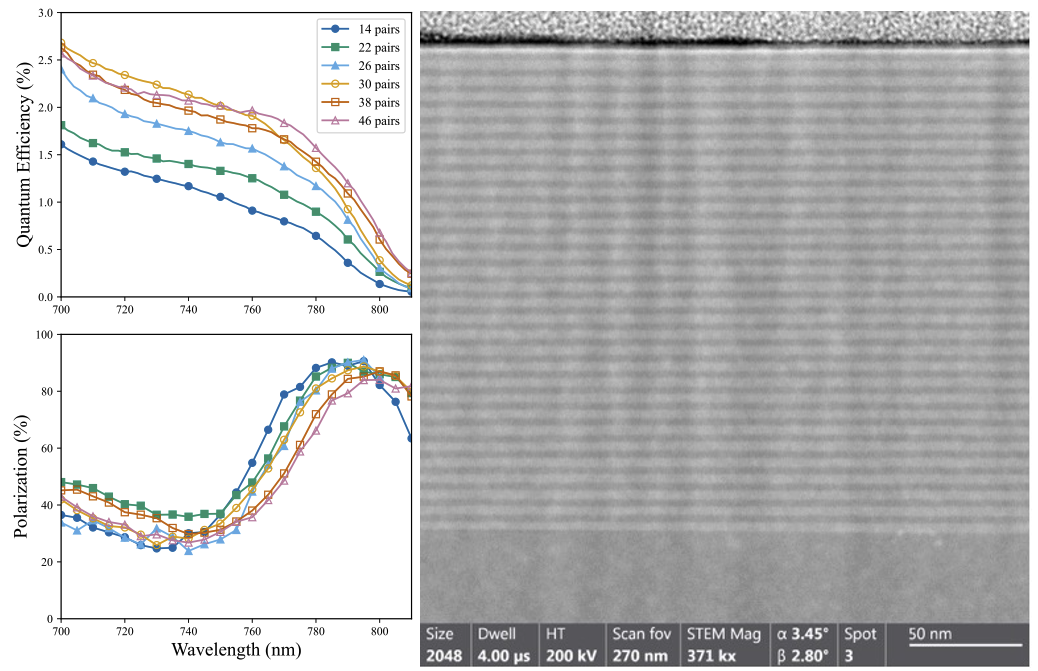
Strained superlattice GaAs photocathodes are crucial for providing high photocurrent beams of spin-polarized electrons at several accelerator facilities including the Continuous Electron Beam Accelerator Facility at Thomas Jefferson National Accelerator Facility and the future Electron-Ion Collider at Brookhaven National Laboratory. In this work, we study the effects of varying the number of superlattice pairs on the polarization and photocurrent of the photocathodes. We observe a saturation in quantum efficiency beyond 30 pairs, with additional layers yielding minimal photocurrent improvement while noticeably reducing the polarization of the beam.
Modeling strain and quantum confinement in GaAs/Ga$_{x}$In$_{1-x}$P superlattices for spin-polarized electron sources
A. Kachwala, G. Blume, S. Marsillac, J. Grames, and M. Grau
J. Appl. Phys.138, 23 (Dec 2025)
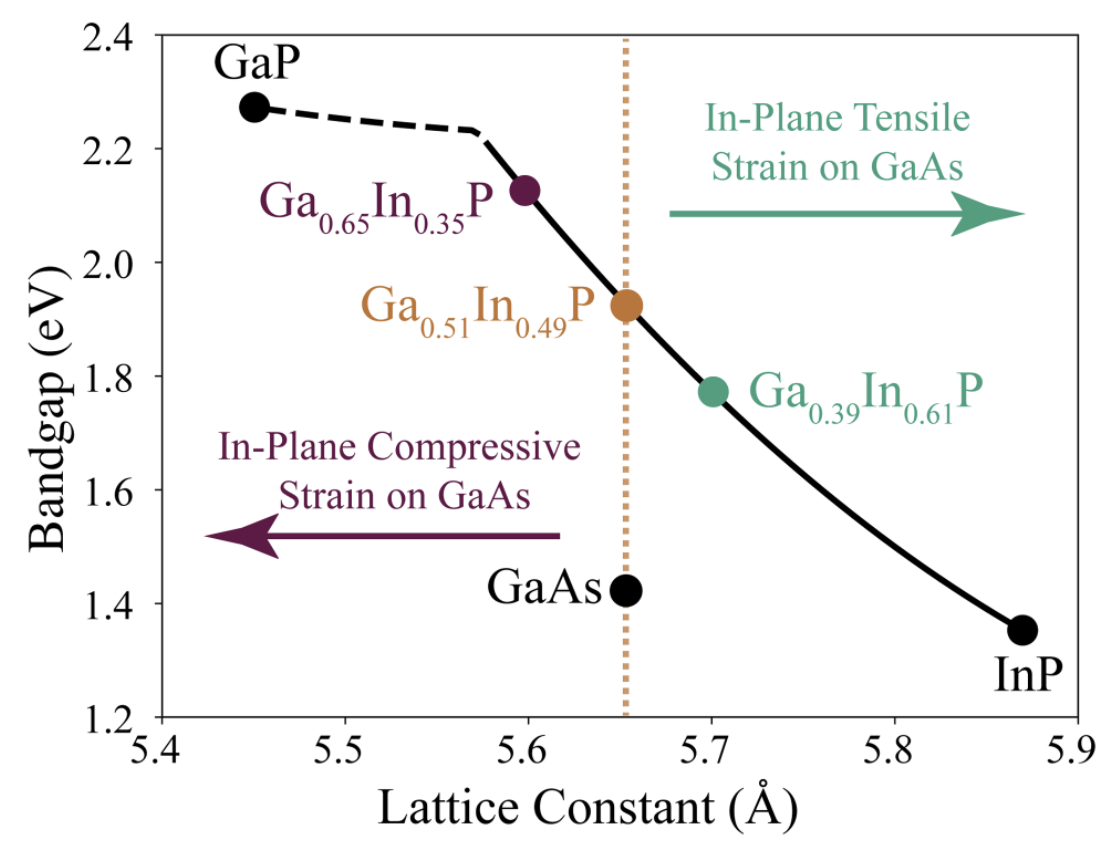
In this study, we systematically design and simulate a series of GaAs-based superlattice configurations aimed at enhancing heavy-hole--light-hole band splitting while simultaneously optimizing band alignment to reduce the conduction band barrier, thereby facilitating efficient electron transport. These combined effects are crucial for achieving high electron spin polarization and high quantum efficiency, the two key performance metrics of next-generation spin-polarized electron sources. We investigated three types of superlattice architectures: (1) compressively strained GaAs wells on GaInP barriers, yielding a maximum band splitting of 140 meV, (2) lattice-matched GaAs/GaInP structures, resulting in the maximum band splitting of 75 meV, and (3) tensile strained GaAs wells on GaInP barriers, with a maximum band splitting of 40 meV. The results demonstrate the tunability of heavy-hole--light-hole band splitting and establish a design framework for high-performance spin-polarized photocathodes based on a combination of strain engineering, quantum confinement, and optimized heterostructure design.
High figure of merit spin polarized electron sources grown via MOCVD
Benjamin Belfore, Adam Masters, Deewakar Poudel, Greg Blume, Stephen Polly, Erdong Wang, Seth M Hubbard, Marcy Stutzman, Joseph Michael Grames, Matt Poelker, Matt Grau, and Sylvain Marsillac
Appl. Phys. Lett.123, 22 (Nov 2023)
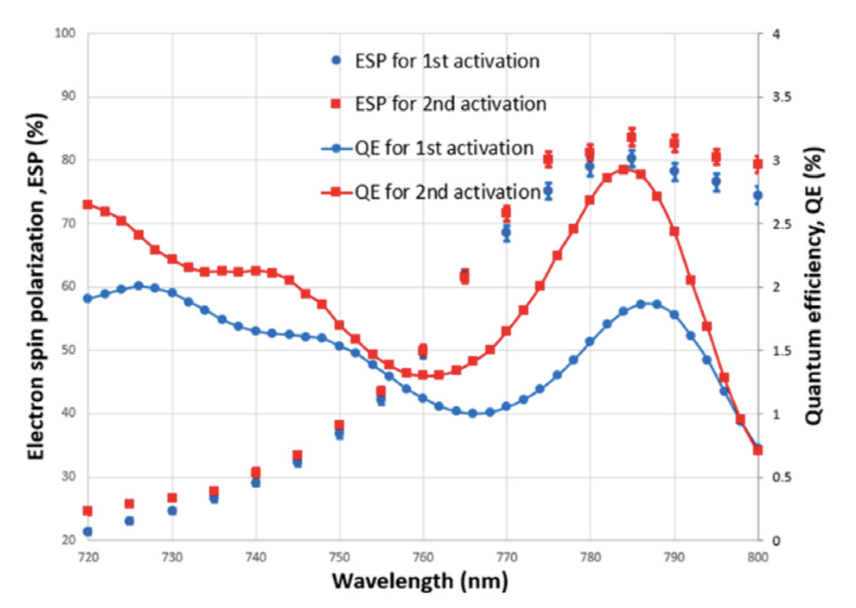
Spin polarized photocathodes are key to the future operation of electron accelerators such as the ones at Thomas Jefferson National Accelerator Facility and Brookhaven National Laboratory. Currently, these photocathodes come in short supply due to limited production by molecular beam epitaxy. By developing a process to implement similar structures using metal organic chemical vapor deposition, the availability of these devices can be increased. In this paper, we detail the implementation of recent photocathode advancements via metal organic chemical vapor deposition process and show an improvement in both polarization and quantum efficiency of our devices compared to those fabricated via molecular beam epitaxy, with devices reaching 82\% polarization and 2.9\% quantum efficiency.

 Fabry-Perot resonance shifts as a novel nondestructive in situ surface damage diagnostic(Sep 2026)
 Cryogenic Enhancement of Electron Spin Polarization from a Strained {GaAs}/{GaAsP} Superlattice Photocathode(Aug 2026)