Trapped-ion platforms for hybrid quantum computation and simulation using both discrete (qubit) and continuous-variable (qumode) degrees of freedom.
This work is done in collaboration with Felix Ringer’s group at Stony Brook University and the QSCOUT at Sandia National Laboratories.
Two Kinds of Quantum Information
A standard quantum computer stores information in qubits, two-level quantum systems, for example the spin of an electron pointing up or down, or an atom in its ground or excited state. But nature is full of systems that can’t be naturally described by just two levels. The electromagnetic field of a laser, the vibration of a molecule, and the oscillation of a mechanical resonator are continuous-variable systems, with an infinite ladder of energy levels.
A hybrid quantum computer uses both. The discrete qubit degrees of freedom handle logic and measurement; the continuous-variable qumode degrees of freedom handle the bosonic, wave-like parts of a problem. Together they can naturally encode the structure of interacting quantum field theories, the language of modern particle and nuclear physics.
Trapped Ions as a Natural Hybrid Platform
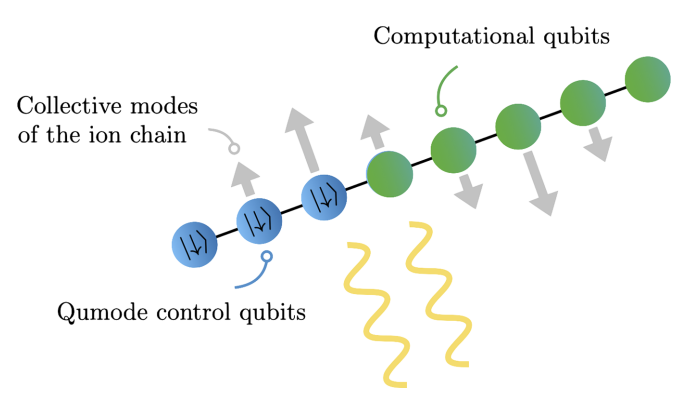
In a chain of trapped ions, these two types of degrees of freedom arise automatically. Each ion has internal energy levels that serve as qubits. The entire chain also has oscillations where all ions move together, like atoms in a crystal, called collective motional modes. These motional modes serve as qumodes, representing bosonic degrees of freedom.
The coupling between an ion’s electronic state and the shared motional modes is well understood and experimentally controllable. This makes trapped ions one of the promising near-term platforms for hybrid quantum computation.
Simulating Quantum Field Theories
A key application of hybrid quantum computing is the simulation of quantum field theories, the fundamental language of particle and nuclear physics, and of many condensed matter phenomena. These theories describe particles as excitations of fields that carry both discrete and continuous degrees of freedom. Classical computers struggle with them, because the quantum state space grows exponentially with system size.
Qubit-qumode representation of the Jaynes-Cummings-Hubbard model. Each site couples a bosonic mode (qumode, top) to a two-level system (qubit, bottom), with photon hopping between adjacent sites.
Trigonometric Continuous-Variable Quantum Gates: Realization with Trapped Ions and Nonperturbative Wigner Negativity
Tommaso Rainaldi, Jake Montgomery, Christopher G. Yale, Brian K. McFarland, Melissa C. Revelle, Daniel Lobser, Edward C. Tortorici, Susan M. Clark, George Siopsis, Matt Grau, and Felix Ringer
(2026)
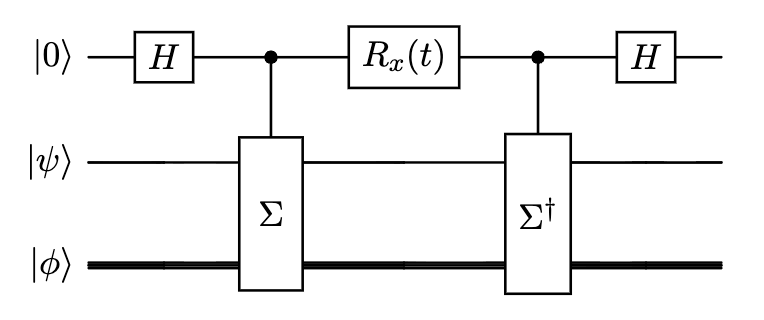
We experimentally realize trigonometric continuous-variable gates on a trapped-ion processor, for which a motional mode acquires a phase proportional to the cosine of its position quadrature, and, for the first time, implement the two-mode generalization, coupling two modes through a single nonlinear phase. Such gates provide an experimentally accessible, nonpolynomial primitive for periodic interactions acting on both compact and noncompact degrees of freedom, including rotor models, sine-Gordon-type systems, and lattice gauge theories. Scanning gate strength, spatial frequency, and circuit depth, we resolve via blue-sideband spectroscopy the parity selection rule that fingerprints the exact cosine evolution, and find that an open-system model incorporating residual thermal occupation and motional dephasing reproduces the data. We then derive the asymptotics of the Wigner negativity generated by these gates and find three scaling regimes. The negativity is beyond all algebraic orders in the gate strength while the negative regions sit in far phase-space tails, becomes linear once they reach the bulk, where it saturates a first-order bound we establish, and logarithmic at strong gate strength. These results expose a general mechanism, first identified here through the cosine gate, by which every finite-order perturbative estimate of a non-Gaussian resource can vanish even though the resource itself remains nonzero. Together, our results establish trigonometric gates as controllable, experimentally realizable building blocks for bosonic quantum simulation, expanding the class of nonlinear dynamics accessible to continuous-variable quantum processors.
Trigonometric continuous-variable gates and hybrid quantum simulations
Tommaso Rainaldi, Victor Ale, Matt Grau, Dmitri Kharzeev, Enrique Rico, Felix Ringer, Pubasha Shome, and George Siopsis
Journal of High Energy Physics2026, 3 (Mar 2026)
Hybrid qubit-qumode quantum computing platforms provide a natural setting for simulating interacting bosonic quantum field theories. However, existing continuous-variable gate constructions rely predominantly on polynomial functions of canonical quadratures. In this work, we introduce a complementary universality paradigm based on trigonometric continuous-variable gates, which enable a Fourier-like representation of bosonic operators and are particularly well suited for periodic and non-perturbative interactions. We present an ancilla-based framework for implementing trigonometric gates with arguments given by arbitrary Hermitian functions of qumode quadratures. The protocol yields unitary gates deterministically, and non-unitary gates through probabilistic post-selection. As a concrete application, we develop a hybrid qubit-qumode quantum simulation of the lattice sine-Gordon model. Using these gates, we prepare ground states via quantum imaginary-time evolution, simulate real-time dynamics, compute time-dependent vertex two-point correlation functions, and extract quantum kink profiles under topological boundary conditions. Our results demonstrate that trigonometric continuous-variable gates provide a physically natural framework for simulating interacting field theories on near-term hybrid quantum hardware, while establishing a parallel route to universality beyond polynomial gate constructions. We expect that the trigonometric gates introduced here to find broader applications, including quantum simulations of condensed matter systems, quantum chemistry, and biological models.
Hybrid quantum simulations with qubits and qumodes on trapped-ion platforms
Jack Y. Araz, Matt Grau, Jake Montgomery, and Felix Ringer
Phys. Rev. A112, 1 (Jul 2025)
We explore the feasibility of gate-based hybrid quantum computing using both discrete (qubit) and continuous (qumode) variables on trapped-ion platforms. Trapped-ion systems have demonstrated record one- and two-qubit gate fidelities and long qubit coherence times, while qumodes, which can be represented by the collective vibrational modes of the ion chain, have remained relatively unexplored for their use in computing. Using numerical simulations, we show that high-fidelity hybrid gates and measurement operations can be achieved for existing trapped-ion quantum platforms. As an exemplary application, we consider quantum simulations of the Jaynes-Cummings-Hubbard model, which is given by a one-dimensional chain of interacting spin and boson degrees of freedom. Using classical simulations, we study its real-time evolution and develop a suitable variational quantum algorithm for ground state preparation. Our results motivate further studies of hybrid quantum computing in this context, which may lead to direct applications in condensed matter and fundamental particle and nuclear physics.
State preparation of lattice field theories using quantum optimal control
Jack Y. Araz, Siddhanth Bhowmick, Matt Grau, Thomas J. McEntire, and Felix Ringer
Phys. Rev. D111, 3 (Feb 2025)
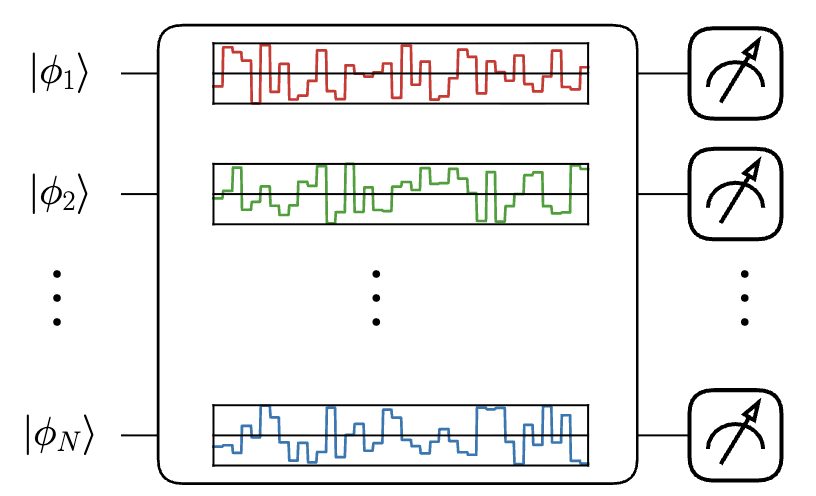
We explore the application of quantum optimal control (QOC) techniques to state preparation of lattice field theories on quantum computers. As a first example, we focus on the Schwinger model, quantum electrodynamics in 1+1 dimensions. We demonstrate that QOC can significantly speed up the ground state preparation compared to gate-based methods, even for models with long-range interactions. Using classical simulations, we explore the dependence on the inter-qubit coupling strength and the device connectivity, and we study the optimization in the presence of noise. While our simulations indicate potential speedups, the results strongly depend on the device specifications. In addition, we perform exploratory studies on the preparation of thermal states. Our results motivate further studies of QOC techniques in the context of quantum simulations for fundamental physics.

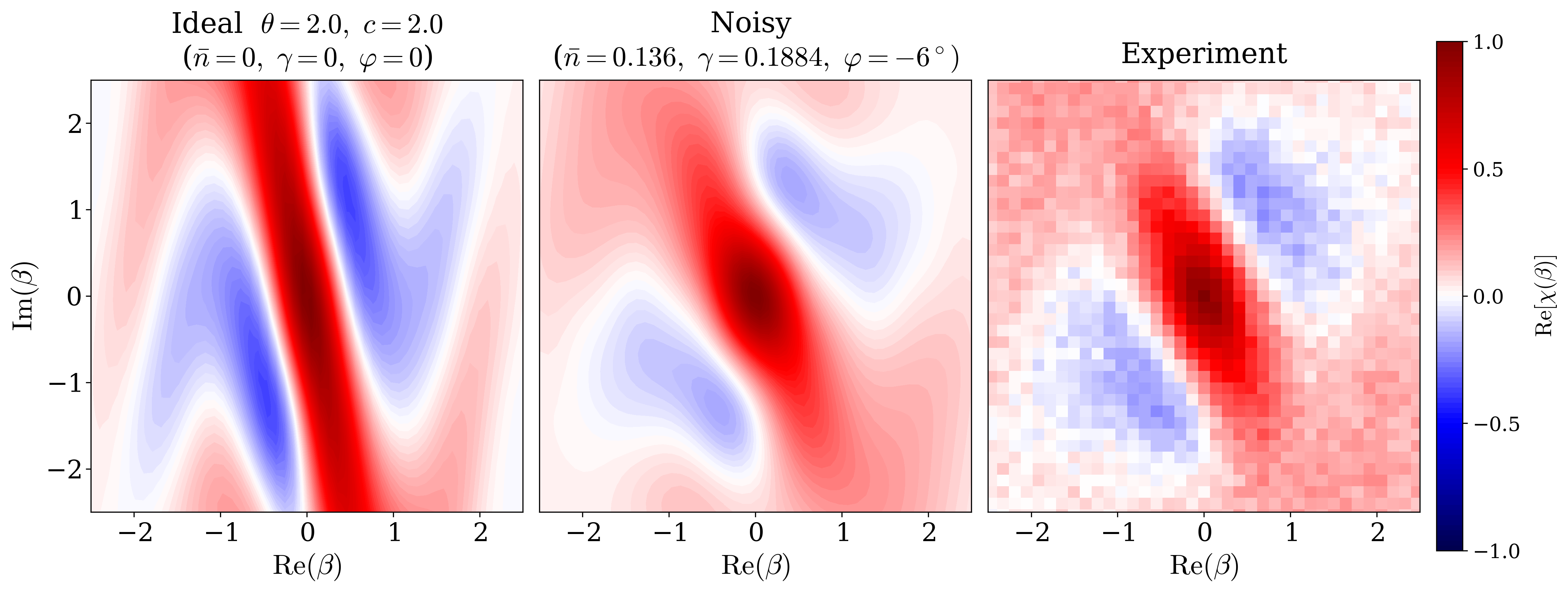 Trigonometric Continuous-Variable Quantum Gates: Realization with Trapped Ions and Nonperturbative Wigner Negativity(2026)